

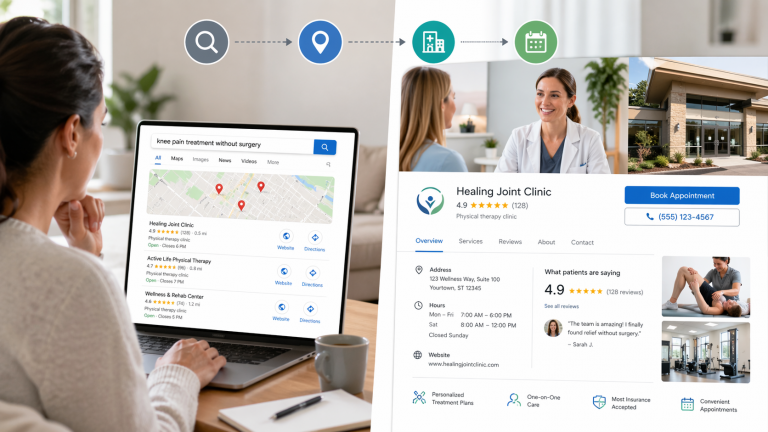
Getting more patients starts with a simple question: which patients does your medical practice actually want more of? A clinic can increase calls and form submissions without improving revenue, filling the right appointments, or attracting people who fit its services. Before adding another marketing tactic, decide which treatments, conditions, locations, and patient relationships matter most.
The next step is to find where growth is breaking down. Some practices are difficult to find. Others get traffic but do not earn trust. Some lose qualified inquiries because calls go unanswered or follow-up stops after one attempt. A useful patient-growth plan connects visibility, credibility, access, and follow-up instead of treating each channel as a separate project.
Key takeaways
- Choose the services and patient relationships you want to grow before buying more traffic.
- Strengthen Google visibility, useful service content, reviews, and referral relationships together.
- Make it easy to call, request information, and schedule from a phone.
- Track qualified inquiries, scheduled appointments, show rates, treatment starts, and revenue, not traffic alone.
- Fix missed calls and weak follow-up before spending heavily on advertising.
Start With the Patients and Services You Want to Grow
“More patients” is too broad to guide a useful strategy. A functional medicine clinic may want more complex consultations. A regenerative practice may want to grow one procedure without overwhelming its clinical team. A specialist may need better physician referrals rather than a larger volume of general inquiries.
Start by answering four questions:
- Which services have capacity?
- Which patients are the best clinical and financial fit?
- How far will those patients realistically travel?
- What would make an inquiry qualified?
Those answers affect the keywords you pursue, the pages you build, the areas you target, and the calls to action you use. They also prevent the common mistake of paying for attention that the practice cannot convert or serve well.
Make the Practice Easy to Find in Google
For many medical practices, Google is where a prospective patient first encounters the clinic. That may happen through a map result, a condition search, a treatment page, a physician’s name, or a question about symptoms.
Begin with the fundamentals:
- Keep the Google Business Profile accurate and complete.
- Use the correct primary and secondary business categories.
- Maintain consistent practice names, addresses, phone numbers, hours, and website links.
- Add real photographs of the office, team, and providers.
- Separate practice and practitioner listings carefully when both are appropriate.
- Build useful pages for important services, conditions, and locations.
Google provides detailed Business Profile guidelines covering names, locations, eligibility, and representation. These rules matter because duplicate, misleading, or inconsistent listings can create problems that more content will not solve.
Build Content Around Patient Questions and Clinical Expertise
Medical practices often describe services in provider language while patients search in practical language. A clinician may talk about prolotherapy, neurofeedback, or therapeutic plasma exchange. A prospective patient may begin with knee pain without surgery, help with brain fog, or treatment options for a diagnosed condition.
A strong site connects those two vocabularies. Service pages explain what the practice offers. Condition and symptom pages help people understand when a service may be relevant. Educational articles answer narrower questions and link readers to the appropriate next step.
This structure also protects against SEO cannibalization. One page should own the main treatment or service intent. Supporting articles should answer related questions and link back to that page instead of competing with it.
Marketing Doctors explains the healthcare-specific search process on our healthcare SEO agency page. Clinics in functional and integrative medicine can also review our functional medicine SEO approach.
Earn Trust Before Asking for an Appointment
Visibility creates an opportunity. Trust determines whether the patient acts.
A medical website should quickly establish:
- who provides the care;
- the provider’s credentials and relevant experience;
- which patients and conditions the practice serves;
- where care is provided;
- what a patient can expect next; and
- how to contact the practice.
Real photographs, complete provider biographies, clear explanations, privacy-conscious testimonials, and transparent contact information are usually more persuasive than broad claims about being “the best.” Avoid guarantees and unsupported outcome language. Specific, verifiable information gives patients something useful to evaluate.
Build a Responsible Review System
Reviews influence both trust and local visibility, but they should be earned through a consistent and ethical process.
Ask eligible patients for honest feedback without telling them what to write. Make the request easy to complete, train the front desk on the process, and respond professionally without confirming that a reviewer is a patient or revealing health information. Review patterns can also expose operational problems such as long waits, unclear billing, or poor communication.
Do not treat reputation management as a campaign that runs only when ratings fall. It should be part of the patient experience and normal practice operations.
Strengthen Patient and Professional Referrals
Search is important, but many practices grow through relationships. Patient referrals, physician relationships, community organizations, and aligned professional networks can produce highly qualified introductions.
Referral growth should be organized rather than left to chance:
- Identify the physicians and professionals who encounter the patients you can help.
- Explain clearly which cases are appropriate for referral.
- Make records, scheduling, and communication easy for the referring office.
- Close the loop when privacy rules and patient permissions allow.
- Give satisfied patients a simple, appropriate way to recommend the practice.
- Track referral sources in the scheduling and intake process.
The point is not to pressure people for referrals. It is to make the practice memorable, responsive, and easy to work with.
Remove Friction From Calling and Scheduling
A clinic can rank well and still lose patients between the search result and the appointment book. Test the complete path on a phone:
- Can a visitor understand the service quickly?
- Is the phone number easy to tap?
- Is the form short enough to finish?
- Does someone answer during business hours?
- What happens after a missed call?
- How quickly does the practice respond?
- Can staff explain the next step clearly?
Missed calls and slow responses deserve special attention. If advertising increases inquiries but nobody consistently answers or follows up, the campaign may appear ineffective even though the operational handoff is the real problem.
Use Paid Media Selectively
Paid search, Facebook and Instagram advertising, YouTube promotion, and connected TV can support growth when the audience, offer, and tracking are clear. They should not be used as substitutes for a weak website or an unreliable intake process.
Healthcare advertising also has policy and privacy constraints. Services involving sensitive conditions, personalized advertising, restricted treatments, or certain claims may have limited targeting or approval options. Review the applicable platform rules before developing the campaign, landing page, or tracking setup.
Paid media is most useful when the practice knows:
- which service it wants to grow;
- what a qualified inquiry is worth;
- where the right patients live;
- whether the landing page matches the advertisement; and
- how calls, forms, appointments, and revenue will be attributed.
Follow Up Until There Is a Clear Answer
One response attempt is rarely a follow-up system. Prospective patients may be working, comparing options, waiting for family input, or unsure what the first visit involves.
Create a simple process with an owner and a next action. Respond promptly, explain what happens next, record the outcome, and schedule another appropriate contact when the person has not decided. Stop when the person declines or asks not to be contacted.
The same discipline applies to physician relationships and other referrals. No promising relationship should disappear because the next action was never recorded.
Measure Patient Growth, Not Marketing Activity
Traffic, rankings, impressions, and clicks help diagnose marketing performance. They are not the business result.
Track the path from inquiry to revenue:
- qualified calls and forms;
- scheduled appointments;
- appointment show rate;
- consultations or evaluations completed;
- treatment starts or accepted plans;
- revenue by service and source;
- cost per qualified inquiry; and
- cost per acquired patient.
Review the numbers by service, location, and source when possible. That makes it easier to distinguish a visibility problem from a conversion, scheduling, affordability, or capacity problem.
Choose the First Improvement Based on the Bottleneck
The best next step depends on what is failing now.
- If the practice is rarely found, begin with local search, service pages, and technical SEO.
- If people visit but do not contact the clinic, improve clarity, trust, and calls to action.
- If inquiries are plentiful but appointments are not, review answering, qualification, affordability, and follow-up.
- If appointments are scheduled but patients do not arrive, examine reminders, expectations, and intake friction.
- If the practice depends on a small number of referral sources, build a broader and better-documented relationship pipeline.
For a broader view of the topic, Zocdoc also offers a practical guide on how to get more patients.
Frequently Asked Questions
How can a medical practice get more patients from Google?
Improve the Google Business Profile, publish focused service and condition pages, strengthen local signals, earn honest reviews, and make the next step obvious. Search visibility works best when the website matches how prospective patients describe their problems and makes it easy to contact the practice.
Should a medical practice focus on SEO or Google Ads first?
SEO is usually the stronger foundation because it improves the website and builds visibility over time. Google Ads can add faster reach for eligible services, but it works best when the landing page, intake process, policy compliance, and conversion tracking are already sound.
What kind of content helps a medical practice attract patients?
Useful content answers the questions patients ask before choosing care. Strong topics include conditions, symptoms, treatment options, candidacy, what to expect, recovery, costs when appropriate, and how one option differs from another. Each article should support a relevant service or condition page.
How can a medical practice get more referrals?
Clarify which patients are a good fit, build relationships with aligned professionals, communicate promptly, make referrals easy to complete, and track where introductions originate. Satisfied patients should also have a simple, ethical way to share their experience and recommend the practice.
Why is a clinic getting traffic but not appointments?
The page may attract the wrong audience, explain the service poorly, lack trust signals, or make contacting the practice difficult. Missed calls, slow responses, confusing forms, unclear pricing expectations, and weak follow-up can also prevent inquiries from becoming appointments.
What should a medical practice measure?
Track qualified inquiries, scheduled appointments, show rates, consultations, treatment starts, revenue, and acquisition cost by service and source. Rankings and traffic are useful diagnostic measures, but they should be connected to patient and revenue outcomes.
Build a Patient-Growth System the Practice Can Maintain
More visibility helps only when the practice can turn attention into trust, appointments, and appropriate care. Start with the service and patient relationship you want to grow, identify the weakest step in the path, and fix that bottleneck before adding more channels.
Marketing Doctors helps medical practices connect search visibility, paid acquisition, content, analytics, and intake follow-up around the services they need to grow. If you want an evidence-based plan for how to get more patients, contact us for a practical review of your current patient-growth system.