

Content review edition | Updated October 12, 2026
Content marketing for medical practices should help you decide which patient questions deserve an answer and whether that answer helps appropriate people contact your office. If you already have a website and publish articles, the next question is practical: can someone tell when your practice is the right place to call?
For a medical practice, content marketing means publishing useful service explanations, articles and answers to patient questions. The Content Marketing Institute explains the broader approach behind content marketing for medical practices: useful information for a defined audience, tied to a business goal.
A service list may describe your expertise without explaining how it relates to the concern that brought someone to your website. Before paying for another article, choose one important question and inspect the answer you already provide. This example shows what to check, what Marketing Doctors could help you improve, and how you could judge the result.
Start with a question that matters to your practice
Imagine an established specialty practice with room for appropriate new patients. Its owner publishes articles but cannot tell whether they help people choose the office. This is a hypothetical example, not a completed client project or a promised result.
Our Patient Discovery Study #1 included this question:
I’ve seen several specialists for symptoms affecting different parts of my body, but nobody has figured out what’s wrong. What kind of doctor should I see?
Researchers prepared this wording from the needs represented in the study material. It is not a verbatim patient quotation or a search phrase with verified demand.
For the practice owner, the first decision is whether the office has an appropriate role in this situation. That requires the clinician’s input. If the practice cannot help with the concern, choose a different question. An article should reflect the people your office can serve.
If the question is relevant, compare it with the questions your staff actually hear before appointments, the queries appearing in your website’s search data, and the concerns patients need explained. Use aggregate themes rather than identifiable patient stories. A useful starting question has both a real audience need and a clear connection to your practice.
Check whether your existing page helps someone decide
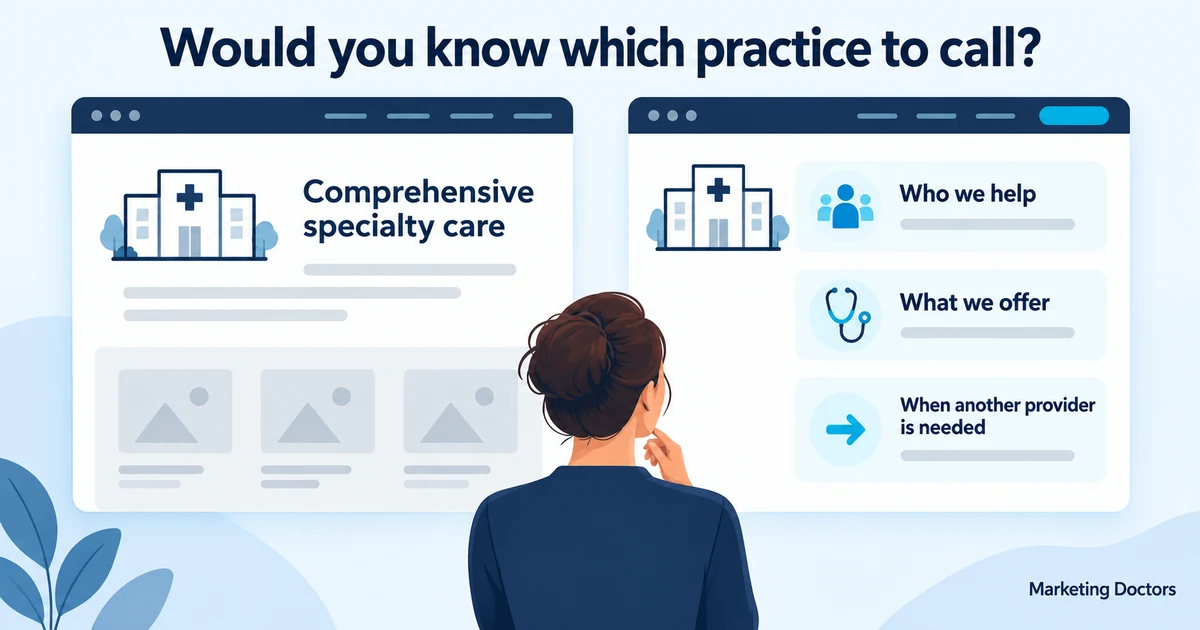
Put the patient question beside the page you expect to answer it. A broad statement such as “We provide comprehensive specialty care” gives little help with choosing a next step. Look for specific information instead:
- Which concerns does your office evaluate, and whom does it serve?
- What happens during the evaluation, and what are its limits?
- How do you work with existing clinicians or refer to another provider?
- What access details could change the decision, such as location, age limits, referral requirements or payment arrangements?
- What should someone do next if the practice appears relevant?
Only include details your practice can verify. The goal is to help someone recognize a reasonable fit, not diagnose them through a marketing page.
This check may reveal that you need to revise one existing paragraph, make a useful service page easier to find, or explain a missing boundary. It may also show that the answer is already adequate. You should be able to see why a proposed change deserves your time and budget.
Explain what your practice doesn’t do
It can feel counterintuitive to use valuable website space explaining what your practice doesn’t offer. You want people to see your expertise and contact you. But someone choosing a provider also needs to recognize when your practice would be the wrong fit.
A service list may leave that unclear. Does the practice evaluate a condition, provide ongoing treatment, or refer patients elsewhere? Does it see children or only adults? Which needs require another specialist? State the boundaries that could change someone’s decision to contact you.
For example, a practice that evaluates memory concerns should explain whether it also provides ongoing dementia care. A reader should not have to assume that offering an evaluation means providing every service that might follow.
Useful boundaries belong beside the relevant service description. Explain what you provide, where your role ends, and how referrals work when another provider is needed.
These details also give search and AI systems more specific information about whom the practice can serve. Whether that produces more accurate recommendations or better-qualified inquiries is something to test. The immediate purpose is clear: help people judge whether your practice fits their needs before they contact you.
What Marketing Doctors would help you produce
For this example, our proposed work would turn the question into a small, documented content decision. You would be able to inspect the evidence, the proposed changes and the responsibilities before investing in a larger content program.
| Work | What you receive |
|---|---|
| Choose the question | A short priority list connecting audience questions, available keyword data, practice scope and capacity. |
| Review the current answer | An annotated page showing what is clear, what is missing and what needs clinician confirmation. |
| Improve the explanation | A revised page or article that explains your role, meaningful exclusions and next steps, with a link to the appropriate service information. |
| Check discovery | A baseline of relevant search visibility and dated samples from selected AI systems, with the prompts and conditions recorded. |
| Evaluate the response | A report separating visits, suitable inquiries and appointments wherever the practice can supply reliable data. |
Marketing Doctors handles the audience research, search research, content assessment and proposed implementation. Your team confirms the clinical explanation and actual operating details. Together, we agree what counts as an appropriate inquiry and which results can realistically be measured.
This builds on our search engine optimization work. The value to you is a specific reason for the content decision, a clearer account of what your practice offers, and a way to evaluate the response. If the main problem is unanswered calls, appointment availability or another part of the process, that finding should change the recommendation.
Measure suitable inquiries, not just article visits
Before changing the page, record what you can reliably observe. After the change, use the same definitions so that the comparison means something.
- Can the answer be found? Track relevant search impressions and visits. Treat sampled AI answers as observations from particular tests, not a complete account of what every person sees.
- Does it lead to useful information? Check movement to the relevant service or contact page.
- Are the inquiries appropriate? Review aggregate inquiry reasons against your services, location, age limits and capacity. Record recurring misunderstandings.
- Do inquiries become appointments? Where the data permits, connect the source to scheduled and completed appointments.
Ask whether people are arriving with a clearer understanding of your role. Fewer mistaken inquiries could be useful even if total inquiry volume does not rise. That is a result to measure, not an improvement we can assume.
Record other changes, including advertising, referral activity, staffing and availability. A rise in appointments after several simultaneous changes does not tell you which change caused it. Our broader guide to getting more patients for a medical practice covers the larger growth question.
How our study informs this example
Marketing Doctors’ exploratory study compared an archived search assessment with answers from ChatGPT, Gemini and Kimi across 25 healthcare-discovery questions. AI scored higher on the unresolved-health group. Search matched or exceeded AI on the cognitive-health group.
That contrast gives us a reason to examine particular questions rather than assume one channel always provides the better answer. The search and AI responses were evaluated under different conditions, and the study did not test a website change, patient decisions, clinical accuracy or appointments.
The example here is a proposed application of that research. Read Patient Discovery Study #1 for the findings, methods and limitations. Its questions, scores and calculations are available separately.
Try this with one question before commissioning more content
Ask your team for one question that regularly needs explanation before an appointment. Confirm that it belongs within your practice’s scope, then read the relevant page as someone who has not yet chosen a provider. Can that person understand what you offer, what you do not offer, and whether contacting you makes sense?
Bring that question and the page to Marketing Doctors. We can discuss what needs investigation and whether a focused content review is a useful next step. Talk with Marketing Doctors about content marketing for medical practices.
Research and editorial disclosure: Marketing Doctors conducted Study #1 using internal resources and has a commercial interest in healthcare marketing. Eric L. Clark is the accountable editor; Chispa and other AI systems contributed to the research and writing, as disclosed in the study. This article presents a hypothetical application, not a completed client case or medical advice. Website content review is in progress.