
Content marketing for medical practices starts with the questions people bring to your office. A service list can describe your expertise. A useful answer shows someone how it relates to their concern and what they can do next. The Content Marketing Institute explains the broader principles behind content marketing for medical practices.
Start with a question that matters to your practice
One of the questions we tested in Patient Discovery Study #1 was this.
I've been sick for a long time, but my blood tests keep coming back normal. What should I do next?
Our research team wrote that question from concerns represented in the study. Now imagine a more specific version comes up at your front desk. Someone says their blood tests came back normal, but they’re still so tired that daily tasks are hard. Can your office help them work out what to do next?
For this example, imagine a primary care practice that evaluates adults with persistent fatigue, reviews prior results, and arranges referrals when appropriate. Before planning the content for a real practice, ask a clinician to confirm what the office can offer.
Look for different ways people describe the same concern. Check the questions your team hears, the searches where your site appears, and public discussions. Google Search Console can show you those search queries. Work with common themes and leave out details that could identify a patient. Note where each question came from so your team can separate what it already hears from ideas it still needs to check.
Check whether your existing page helps someone decide
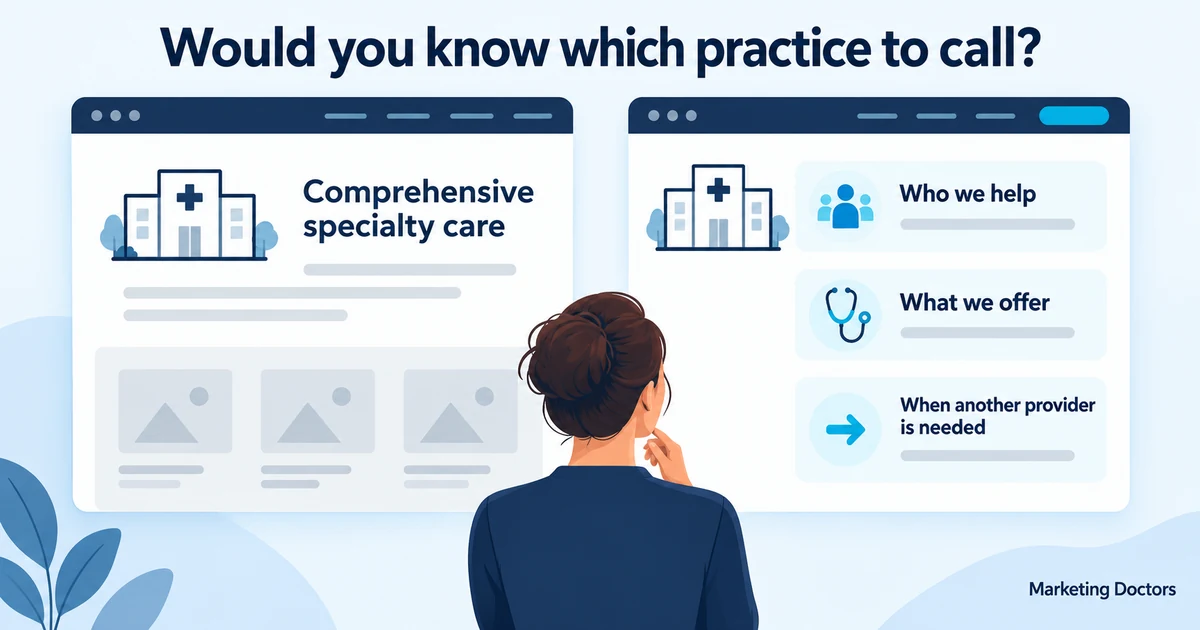
Put the question beside the page your team would send someone to. A line like “We provide comprehensive care” leaves a lot open. Can people tell whether you review outside results, what to bring to a visit, or whether they need a referral?
AI can help with this part. Give it the questions and a separate, practice-approved list of what you evaluate and which cases you refer. Ask it to group the questions by what the person is trying to decide. Have it keep the source with each question and flag details that might change the answer. A clinician can then confirm whether any of those details change what’s worth evaluating. Ask your front desk to confirm the appointment details.
Filled-in worksheet for the fatigue example
These questions are examples. The first three could go on one page because they take someone from understanding their results to preparing for a visit. The fourth adds a detail a clinician may want to address separately.
| What might the person ask? | What are they trying to decide? | What does the practice confirm? | Where should the answer go? |
|---|---|---|---|
| “My blood tests came back normal. Why am I still so tired?” | What the results mean and what a follow-up visit could clarify. | How to explain what was tested and what else an evaluation could consider. | Open the article on persistent fatigue with this question. |
| “Can someone look at the tests I’ve already had?” | Whether this office can help with the next step. | Whether the office evaluates persistent fatigue, reviews outside results, and coordinates with the clinician who ordered the tests. | Explain it in the article and link to the evaluation or appointment page. |
| “What should I bring if I go back?” | How to prepare for the visit. | Which results and medication details are useful, and what the clinician would want to know about when the fatigue started and how it affects daily life. | Add a short list to the article or link to one on the appointment page. |
| “I wake up tired, and my partner says I snore loudly. Could that matter?” | Whether to mention what happens while they sleep. | Whether that detail is worth explaining and whether the practice evaluates sleep concerns or refers them. | Add a short explanation and, with clinician approval, link to an existing sleep evaluation or sleep apnea page. |
To understand a result within the normal range, first ask what the test measured. When evaluating persistent fatigue, a clinician may also consider the person’s history, medications, sleep, and findings from the physical exam. Loud snoring and daytime sleepiness can make sleep apnea worth discussing. A clinician can explain that connection when it fits the question and the care the practice offers. MedlinePlus on lab results · American Family Physician on evaluating fatigue · NIH on sleep apnea symptoms
Once you’ve filled in the worksheet, look again at what you already have. You may only need to improve one paragraph or make the appointment instructions easier to find. Write a separate article when the question needs enough explanation to stand on its own.
Explain where your practice’s role ends
Evaluating a concern and providing ongoing treatment are different services. If your office evaluates persistent fatigue and refers patients elsewhere for some kinds of care, say so beside the service description. Explain what you can evaluate, when another clinician gets involved, and how the referral works. That gives someone a clearer basis for deciding whether to call.
What Marketing Doctors would help you produce
In this example, we’d turn the question into a specific, documented decision about what to improve. You could review the evidence, see what we propose, and agree on who handles each part before investing in a larger program.
| Work | What you’d get |
|---|---|
| Choose the question | A short list of priorities that connects patient questions and available search data with your services and capacity. |
| Review the current answer | An annotated page that shows what’s clear, what’s missing, and what a clinician needs to confirm. |
| Improve the explanation | A revised page or article that explains what your practice does, where its role ends, and what to do next, with a link to the relevant service. |
| Check how people find the page | A baseline for search visibility and dated samples of AI answers, with the questions and conditions for each test recorded. |
| Evaluate the response | A report that separates visits, inquiries that fit your practice, and appointments, where reliable data is available. |
Marketing Doctors researches what people ask and search for, reviews the content, and proposes how to update the site. Your team confirms the clinical explanation and how your office works. Together we agree which inquiries fit your services and what we can measure. Healthcare marketing research
This builds on our search engine optimization work. You should know why a change is worth making, how to explain your services more clearly, and how to judge the result. If the main problem is unanswered calls, limited appointments, or another step in the process, that should change the recommendation. Healthcare SEO
Measure whether the inquiries fit your practice
Before changing the page, record what you can reliably observe. Use the same definitions afterward so the comparison is useful. Healthcare marketing analytics
- Can people find the answer? Review impressions and visits from relevant searches. Treat AI answers as observations from specific tests.
- Does the page lead to useful information? Check whether people move on to the relevant service or contact page.
- Do the inquiries fit what you offer? Compare common reasons for calling with your services, location, age limits, and capacity. Note misunderstandings that keep coming up.
- Do inquiries become appointments? Where the data allows, connect the inquiry source to appointments booked and appointments completed.
Ask whether people call with a clearer idea of what your office does. In the fatigue example, ask your front desk whether callers still need to check if you review lab results from other offices. Fewer calls about services you don’t offer can be useful even if the total number of inquiries stays the same.
Record changes in advertising, referrals, staffing, and availability. If appointments rise after several things change at once, take those changes into account when you interpret the result. How to get more patients for a medical practice
What our study adds to this example
In this exploratory study, Marketing Doctors compared an archived assessment of traditional search with answers from ChatGPT, Gemini, and Kimi to 25 questions about finding health information and care. In the group of five questions about unresolved health problems, each AI system outscored traditional search on average. Across the five cognitive-health questions, search matched the highest AI score.
That difference gives us a reason to look at the questions individually. Search and AI answers were evaluated under different conditions. The scores reflect the study’s rating criteria. The fatigue worksheet is one way to apply the study to a practice website. Its effect on patient decisions and appointments still needs to be tested. Patient Discovery Study #1 · Questions, scores, and calculations
Try one question before commissioning more content
Start with your front desk. Pick one question the team hears before appointments, open the page they usually send people to, and fill in one row below. You can do that before asking for the doctor’s time.
Then bring the clinician the one question your team needs answered. For the fatigue example, that might be “What can we tell someone about the evaluation we offer when they’re still tired after normal blood tests?” Once you have the answer, decide where it belongs.
Blank worksheet for your practice
| Patient question and source | What are they trying to decide? | What can our practice verify or explain? | Which page should answer it? |
|---|---|---|---|
Bring that question and the page to Marketing Doctors. We can talk through what needs a closer look and whether a focused review would help. Talk with Marketing Doctors about content marketing for medical practices.
Research and editorial disclosure
Marketing Doctors conducted the study using internal resources and has a commercial interest in healthcare marketing. Chispa and other AI systems contributed to the research and writing, as disclosed in the study. The clinic example is hypothetical and illustrates a method for planning content. Eric L. Clark is the accountable editor.
Originally published:
Updated: